

Table of Contents
- The Real Reasons Standard Sizing Fails Tall Frames
- How to Measure Inseam for Pants (and Why It Matters)
- Tall Women Clothing Proportions: Torso, Rise, and Sleeve Length
- The Bend Point Problem: Why Knees and Hems Never Land Right
- How to Find Clothes That Fit Long Torsos
- Why Retail Availability for Tall Sizes Is Still So Limited
- Tailoring Hacks and Sustainable Options for True Tall Fit
- Frequently Asked Questions
Last Updated: September 17, 2026
The Real Reasons Standard Sizing Fails Tall Frames
Walk into almost any store and the size range stops at a point that assumes an average height. That assumption is the root of why do tall women struggle finding true tall fit clothing. Standard sizing is built around a mid-range body, and everything from the shoulder seam to the hem is graded from that single reference point.
Standard sizing is a system that scales one baseline body up and down, not a system built for height. When a brand "adds tall sizes," it often just lengthens the hem and calls it done. The shoulders, sleeves, rise, and torso stay the same. That is why a pair of "tall" pants can still hit your ankle bone and a "tall" top can still ride up when you raise your arms.
The ASTM International standard guide for body measurements that underpins much of commercial apparel sizing is built on population averages, and those averages cluster around mid-range heights. Tall frames sit at the edge of the bell curve, so the closer you get to 6'0" and beyond, the further the standard pattern drifts from your actual proportions.
That gap is not a flaw in your body. It is a flaw in how the garment was drafted.
How to Measure Inseam for Pants (and Why It Matters)
The single most useful number a tall woman can know is her inseam. Inseam is the distance from the crotch seam of a pair of pants down to the hem, measured along the inside of the leg. It is the measurement that determines whether a pant actually reaches the floor.
Here is how to measure inseam for pants accurately:
- Put on a pair of pants that already fit your rise the way you like.
- Stand straight against a wall with your feet flat and together.
- Have someone run a tape measure from the crotch seam straight down to your ankle bone.
- Record the number in inches and note whether you prefer your hem at the ankle or the floor.
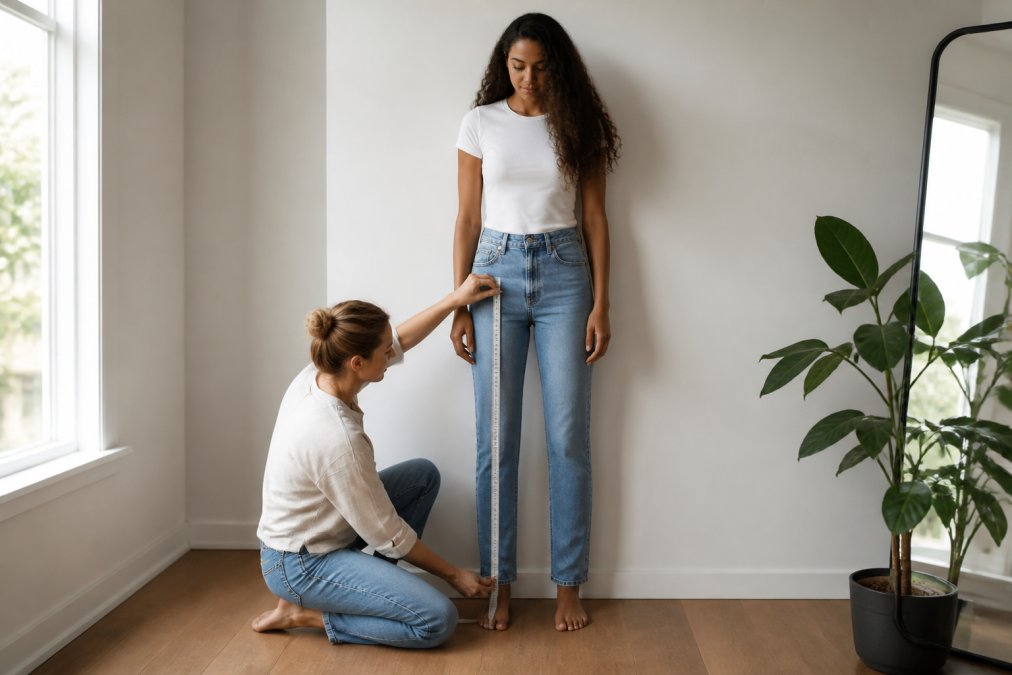
Most mass-market pants are drafted for an inseam in the low 30s. Tall women commonly need 35 to 38 inches. Paryse Style builds its tall pieces around that reality, with inseams ranging from 35" to 38" depending on the style, so the length is there before you ever consider a tailor.
Tall Women Clothing Proportions: Torso, Rise, and Sleeve Length
Height is not one measurement. It is a set of vertical proportions, and two women the same height can carry that height very differently.
Tall women clothing proportions describe how torso length, rise, and limb length distribute across a tall frame. Some tall women have long legs and an average torso. Others have a long torso and average legs. Standard tall sizing usually assumes the first pattern and ignores the second.
That is why the fit issues feel random. A top that fits your friend who is also 6'0" may gap at the waist on you because your torso is longer and the waist seam lands in the wrong place.
Sleeve length is its own problem. A "tall" sleeve is often only an inch or two longer than a regular one, which is nowhere near enough if your arms run long even for your height. The fix is to know your own numbers: torso length, rise, and sleeve length from shoulder seam to wrist bone. Once you have them, you can read a size chart and predict the fit before you order.
The Bend Point Problem: Why Knees and Hems Never Land Right
Here is where the manufacturing math gets obvious. The bend point is where the knee naturally creases a pair of pants, and on a tall frame that point sits higher up the leg than a standard pattern assumes.
When a pant is drafted for an average height, the knee break is placed too low for a tall woman. The result is a crease that digs in behind the knee, fabric that bunches, and a hemline that sits above the shoe. You get baggy knees and a flood-water hem from the same garment.
The textile and apparel sizing research from Cornell University on body dimension variation shows exactly why: a single graded pattern cannot hold its proportions across a wide height range. The taller the wearer, the more the knee placement, rise, and hem drift out of alignment.
This is the problem most tall brands never solve.
How to Find Clothes That Fit Long Torsos
Finding clothes for a long torso comes down to two habits: knowing your torso length and prioritizing brands that publish real garment measurements. But the reason long torsos are so hard to fit is a manufacturing one, and understanding it changes what you look for.
- Measure your torso from the base of your neck (the bony bump at the top of your spine) to your natural waist, the narrowest point above your navel
- Measure your rise: from your natural waist down through the crotch to the top of a chair seat, taken while seated
- Measure your sleeve from the shoulder seam to the wrist bone, arm slightly bent
- Compare those three numbers to the garment's listed length, not the model's height
- Look for adjustable straps, ties, or wrap styles that let you set the drop
- Favor brands that publish flat-lay measurements for each size
- Skip any listing that only shows model shots with no garment numbers
Why Retail Availability for Tall Sizes Is Still So Limited
Retail availability for tall sizes stays thin because of how mass production works, and the numbers explain the gap better than any anecdote. Brands cut fabric in bulk and need every size to sell in volume. Tall sizes serve a smaller slice of the market, so they get dropped from the run or reduced to a token few styles. A buyer placing an order for a national chain has to justify every size slot on the shelf, and a size that turns over slowly loses that slot to a size that turns over fast.
Tailoring Hacks and Sustainable Options for True Tall Fit
Tailoring can rescue a garment, but only when the fabric allows it. You can let down a hem if the brand left extra fabric in the seam allowance. You can raise a waist seam if the construction is simple. What you cannot fix cheaply is a shoulder that sits in the wrong place or a rise that is drafted too short.
Tailoring hacks worth knowing:
- Ask a tailor to check the seam allowance before promising a hem can be let down
- Have sleeves shortened from the shoulder, not the cuff, to keep the armhole intact
- Take in the waist rather than sizing down, so you keep the length you need
- Keep one well-fitted pair of pants as your reference for every future order
Frequently Asked Questions
What is the difference between 'long' and 'true tall' sizing?
Long sizing typically adds 2 to 3 inches to a standard hem, while true tall sizing rebuilds the entire garment pattern for a taller frame. That means adjusting the rise, torso length, sleeve length, and bend point, not just the hemline. A long inseam alone does not fix gapping at the waist or sleeves that stop above the wrist. True tall fit starts from the tall body and works outward.
What height is considered tall for women's clothing?
Most brands begin offering tall sizes at 5'9" or 5'10", but the threshold for needing true tall proportions is usually 5'11" and above. At that height, standard sleeve lengths fall short, rises sit too low, and maxi dresses hit mid-calf instead of the ankle. Women between 5'10" and 6'5" often need dedicated tall fit clothing rather than standard sizes with added length.
Why do many brands just add length to sleeves instead of adjusting proportions?
Adding length to a sleeve is cheap. Rebuilding a pattern for a taller frame requires new grading, new fit testing, and more fabric across every size. Mass production favors one base pattern scaled up or down, so tall fit becomes a hem adjustment rather than a full proportional redesign. That is why tall women still get sleeves that hit the wrist bone and torsos that ride up when they raise their arms.
How do I know the sleeves will actually be long enough before I order?
Check the brand's size chart for a specific sleeve length measurement, not just a size label. Measure your own arm from shoulder seam to wrist bone and compare. Look for brands that list garment construction details like shoulder-to-hem length or actual sleeve inches. If a brand only says 'tall' without numbers, ask for measurements before buying. A clear return policy also protects you if the fit misses.
The frustration tall women feel is not imaginary, and it is not your body's fault. It is the predictable result of a sizing system built for average height and a retail market that would rather lengthen a hem than redraft a pattern. Paryse Style exists to change that equation, designing every piece from the tall frame outward with real sleeve lengths, true rise, and inseams from 35" to 38". Explore the collection and find clothing that fits your height instead of asking you to adapt to it.