

Table of Contents
- Tall Size vs Plus Size Tall: Understanding the Core Difference
- Pattern Grading for Tall Women: How Brands Scale Proportions
- Tall Women Clothing Proportions: Sleeve Length, Torso, and Inseam
- How to Measure Inseam for Pants: Get Your True Length
- The Intersection of Tall and Plus Size: When Both Matter
- Common Misconceptions About Tall vs Plus Size Sizing
- Finding Your Fit: Practical Shopping Tips for Tall Frames
- Conclusion
- Frequently Asked Questions
Last Updated: September 4, 2026
Tall Size vs Plus Size Tall: Understanding the Core Difference
The distinction between tall size vs plus size tall comes down to where the garment is graded: vertically for height or horizontally for width. A true tall size extends the inseam, sleeve length, and torso proportion while keeping the width consistent. A plus size tall, by contrast, must accommodate both additional width and additional length simultaneously, which requires a fundamentally different pattern block.
Many brands take a standard plus-size pattern and simply add inches to the hem, calling it "tall." That approach fails the moment you put the garment on: the crotch sits too low, the sleeves stop at the wrist bone, and the torso pulls across the chest.
Tall size vs plus size tall is a question of garment engineering. When a pattern is graded up in width only, the proportions shift. A woman who is 6'1" and wears a size 16 needs a pattern that starts with her frame and scales outward, not one that starts with a size 22 and stretches downward.
The fashion industry took years to acknowledge plus-size bodies at all. When tall options finally appeared, many brands simply extended the plus-size pattern. Industry analysis of sizing standards and pattern grading shows this shortcut is widespread, which is why so many tall, curvy women have returned endless packages of clothing that promised "tall fit" but delivered neither length nor width correctly.
Pattern Grading for Tall Women: How Brands Scale Proportions
Pattern grading for tall women scales a base pattern to fit longer frames while preserving the original silhouette. The base block must be cut for a specific height, then adjusted proportionally across inseam, rise, sleeve length, and torso. The order of these adjustments determines whether the garment fits or fails.
Most brands grade horizontally, scaling a size 10 block up to a size 18 by adding width at the bust, waist, and hip while keeping vertical measurements fixed. This works for average-height women but fails for tall ones.
Vertical grading is rarer because it requires a separate base pattern engineered for height from the start. A brand offering only a 34-inch inseam on a standard-rise pant has not graded for height; it has simply extended the hem.
The core problem emerges when brands combine these incorrectly. When a plus-size pattern is extended vertically without adjusting the rise, the crotch seam sits too low. When a tall pattern is scaled for width without extending the torso, the waistband sits too high and the shoulders pinch.
Horizontal Grading (Width-First Approach): The rise stays fixed while bust, waist, hip, and sleeve width increase. For a 5'4" woman this works; for a 6'1" woman the crotch seam lands inches too low.
Vertical Grading (Height-First Approach): The pattern starts with a 6'2" frame with extended rise, inseam, sleeve cap, and torso. When graded horizontally for width, all proportions scale together, keeping the rise proportional to the bust and sleeve length proportional to shoulder width.
Tall Women Clothing Proportions: Sleeve Length, Torso, and Inseam
Tall women clothing proportions are governed by three critical measurements: sleeve length, torso length, and inseam. These determine whether a garment fits or merely hangs.
A standard women's sleeve length averages 31 inches; tall women routinely need 33 to 35 inches. This difference changes where the cuff lands and whether the armhole pulls when you raise your arms.
Torso length is the most neglected measurement in tall sizing. A woman who is 6'1" needs a longer rise in pants and longer bodices in dresses and tops. When the torso is too short, waistbands dig in, shirt tails pull out, and wrap dresses gap at the chest.
Standard inseams run 29 to 31 inches; many tall brands offer 34 inches. True tall fit often requires 35 to 38 inches. A plus-size tall pant must have both extended inseam and deeper rise to accommodate curves without sagging.
How to Measure Inseam for Pants: Get Your True Length
Measuring your inseam accurately is the single most reliable way to know whether a pant will fit. The inseam runs from the crotch seam down the inside of the leg to the hem.
Stand with feet shoulder-width apart. Have someone hold a tape measure at the top of your inner thigh where the crotch seam sits, then run it straight down to the floor without curving. Record the number in inches.
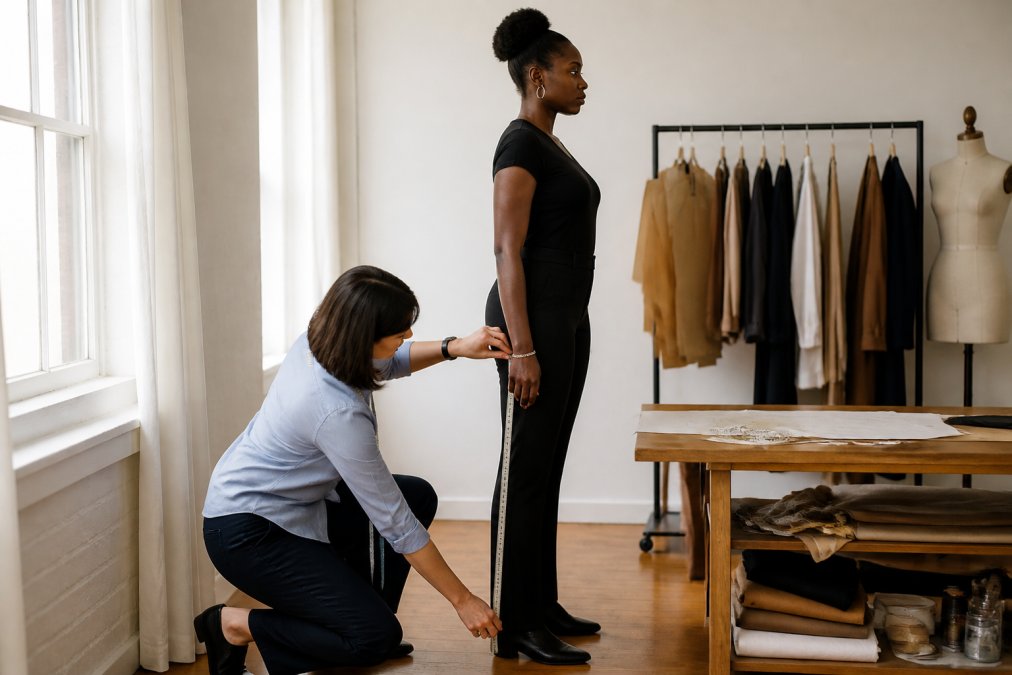
Wear flat shoes or go barefoot and let the tape rest lightly against your leg. For pants you plan to wear with heels, add the heel height to your measurement.
Compare your number against the brand's stated inseam, not the size label. If you measure 36 inches, a pant labeled "tall" with a 34-inch inseam will still be too short. Your measurements matter more than size charts.
The Intersection of Tall and Plus Size: When Both Matter
The intersection of tall and plus size is where the fashion industry most frequently fails its customers. Few brands build for both width and length simultaneously.
A standard plus-size pattern assumes average height. When you add height, every horizontal measurement needs re-evaluation. A dress that fits a 5'6" woman in size 18 will pull across the shoulders and ride up at the waist on a 6'1" woman in the same size.
Women who wear sizes 14/16 and 18/20 have been underserved for so long that when a brand delivers true tall proportions with genuine width, the response is immediate.
The key distinction is that plus-size tall requires both a full-bust adjustment and a length adjustment in the same garment without compromising either. When done correctly, the result is clothing that fits the height, honors the curves, and moves with the body.
Common Misconceptions About Tall vs Plus Size Sizing
Several misconceptions persist about tall vs plus size sizing. They reflect a deeper gap: the fashion industry has trained tall and curvy women to doubt their own bodies rather than doubt the garment.
Misconception 1: Adding length to a plus-size garment makes it tall.
It does not. The rise, crotch curve, and torso length all need adjustment. A longer hem on an ill-fitting crotch simply extends the sagging further down your leg. This misconception is damaging because brands can execute it easily, just add inches to the hem, and it looks like a solution on a hanger. On a body, it fails. Women often blame themselves when the real problem is that the pattern was never designed for their frame.
Misconception 2: Tall sizing only matters for pants.
Sleeves, torsos, and bodices are equally affected. A dress with a 24-inch torso length will gap at the chest and ride up at the waist on a tall woman, no matter how perfectly the hem is adjusted. Retailers focus marketing on inseam length, the easiest measurement to advertise, while ignoring the upper body. Women buy "tall" dresses and find only the hem is longer; the bodice still does not fit.
Misconception 3: Size labels carry consistent meaning across brands.
They do not. Guide to understanding apparel size standards and fit explains that sizing is not standardized across the industry, which is why a size 16 at one retailer can fit like a size 12 at another. A woman who wears a size 16 tall at one brand may need a size 18 tall at another, not because her body changed but because the pattern blocks are different. This misconception is particularly insidious because it makes women feel unstable in their own sizing knowledge. The only reliable approach is to measure your body and compare against each brand's specific size chart, a step that requires effort most shoppers should not have to invest.
Misconception 4: Tall women should simply size up to get more length.
Sizing up adds width everywhere without extending sleeve or torso length, because those proportions are fixed in the pattern. A woman who is 6'1" and wears a size 12 cannot buy a size 16 and expect sleeves to reach her wrists; they will be wider, not longer. This drives a cycle of returns: women buy larger sizes hoping for length, find the garment too wide, return it, then buy the original size, which is too short.
The Confidence Cost
These misconceptions place the burden of fit on the consumer. When a garment does not fit, the industry narrative suggests the woman measured wrong, chose the wrong size, or has an unusual body. In reality, the garment was engineered for a different frame. This repeated experience erodes confidence. Women stop trusting their own measurements, buy multiple sizes in the same style, and avoid silhouettes that have failed them before.
When a brand designs from the tall body outward, starting with a pattern cut for a 6'2" frame and scaling up and down from there, the entire dynamic shifts. The garment fits on the first try. The woman does not question her measurements. She does not wonder if she is the problem. She simply wears the clothes.
Finding Your Fit: Practical Shopping Tips for Tall Frames
Shopping for tall frames requires knowing your three key measurements: inseam, sleeve length, and torso length. Write them down and keep them accessible.
Check whether brands publish inseam measurements for each style. A brand offering a 38-inch inseam commits to tall proportions. A brand that only says "tall" without numbers asks you to trust blindly.
Look for brands that design from the tall body outward rather than adapting standard patterns. This shows up in extended rise lengths, properly placed darts, and sleeve caps that account for longer arms.
Wide-leg pants and palazzo styles showcase a long inseam while forgiving hip and thigh variations. Wrap dresses accommodate curves while allowing torso length adjustment through the tie.
| Fit Priority | Measurement to Check | Why It Matters |
|---|---|---|
| Pants | Inseam | Determines where the hem falls |
| Tops and dresses | Torso length | Prevents pulling and gaping |
| Jackets and blouses | Sleeve length | Ensures cuffs reach the wrist |
| All bottoms | Rise | Prevents sagging crotch |
For women who wear plus sizes, prioritize brands that offer extended sizing built on a tall base pattern. The Amalfi Coast Two-Piece Set from Paryse Style pairs a true 38-inch inseam pant with a matching top in sizes up to 18/20. The Classic Chambray Waistcoat set offers a structured option with the same 38-inch inseam, designed for work and elevated casual wear.

Conclusion
True fit requires vertical and horizontal grading working together. A garment that only adds length to a plus-size pattern, or only adds width to a tall pattern, will never fit properly.
The fashion industry has spent decades telling tall, curvy women to be grateful for whatever almost fits. Research on size inclusivity in the apparel market continues to show how underserved this demographic remains. You deserve clothing designed around your body, not clothing that asks you to adapt to its flaws.
That is the standard Paryse Style was built on. Every piece starts with a pattern cut for a 6'2" frame, then scales up and down to preserve proportions across sizes 4 through 20. Signature 38-inch inseams, real sleeve lengths, and fabrics chosen for movement mean the clothes work with your height and curves.
Stop settling for hems that fall short and sleeves that stop at the wrist. Explore the Paryse Style collection for tall women and find pieces that fit your frame from the first wearing.
Frequently Asked Questions
What is the difference between a tall fit and a plus-size fit?
Tall fit adjusts vertical proportions: longer sleeves, extended torso length, and inseams ranging from 35 to 38 inches. Plus-size fit adjusts horizontal proportions: wider bust, hip, and waist measurements. Tall size vs plus size tall differs fundamentally because they address different body dimensions. A tall woman needs sleeve and inseam length; a plus-size tall woman needs both length AND width. Many brands simply add length to standard plus-size patterns, which creates gaps at the crotch and pulls across the chest, settling for fit rather than delivering it.
How tall should you be to wear tall sizes?
Tall sizing typically suits women 5'10" and taller, though individual proportions matter more than height alone. A woman who is 5'9" with a long torso and 36-inch inseam may need tall proportions, while someone 5'11" with shorter legs might wear regular sizing. The key is measuring your actual inseam, sleeve length, and torso length rather than relying on height alone. Standard sizing assumes a 34-inch inseam; if yours exceeds 35 inches, tall sizing will fit better.
Why do many brands just add length to plus-size patterns?
Adding length to existing plus-size patterns is cheaper and faster than engineering patterns from scratch for tall frames. However, this approach fails tall women because it doesn't adjust the rise (distance from waistband to crotch), sleeve cap height, or torso proportions. The result: pants that hit the crotch too high, sleeves that end mid-forearm, and a silhouette that never feels balanced. True tall sizing requires rebuilding patterns from the ground up, starting with tall body proportions and scaling both width and length together.
How do I know if I need tall sizing or plus-size tall?
Measure three key areas: inseam (hip to ankle), sleeve length (shoulder to wrist), and torso length (shoulder to waist). If your inseam is 35 inches or longer, you need tall sizing. If your bust, waist, or hip measurements fall into plus-size ranges (typically 14+), you need plus-size width. If both apply, seek plus-size tall options designed with true tall proportions, not standard plus-size patterns with added length. Brands that start with a 6'2" frame and scale up and down deliver the fit tall women actually need.