

Table of Contents
- The Real Reasons Tall Clothes Never Fit Right
- Tall Women Clothing Proportions: Why Height and Size Are Not the Same
- How to Measure Inseam for Tall Women (and Other Key Measurements)
- Fashion Tips for Tall Women 2026: What Actually Works
- How Poor Fit Affects Confidence (and Why It Matters)
- DIY Minor Alterations for Tall Clothing
- Frequently Asked Questions
Last Updated: September 16, 2026
The Real Reasons Tall Clothes Never Fit Right
If you have ever pulled a "tall" top off the rack only to find the sleeves stop at your forearm, you already know why tall clothes never fit right. The industry's sizing system was never designed around your frame. This guide from Paryse Style breaks down the manufacturing decisions behind that frustration, then hands you the measurements and fixes that actually work.
Standardized Sizing Was Never Built for Tall Frames
Modern ready-to-wear sizing descends from a system built around average-height bodies, not tall ones. The ASTM International sizing standards for apparel define body dimensions for the "standard" figure, and anything outside that range gets accommodated through a grading formula rather than a genuinely different pattern. When a brand offers "tall," it usually means one inch added to a hem, not a rebuilt silhouette.
Garment Grading Adds Width, Not Length
Garment grading is the process of scaling a base pattern up or down across sizes. Most grading rules add circumference at the bust, waist, and hip, while vertical measurements barely move. The result: a size 16 tall woman gets a wider garment, not a longer one. Sleeve length, torso length, and rise stay nearly fixed across the size run.
Tall Women Clothing Proportions: Why Height and Size Are Not the Same
Tall women clothing proportions describe how your vertical measurements relate to each other, and they matter more than your numeric size. Two women can both stand 6'0" and need completely different sleeve lengths, because height alone does not tell you where your waist sits, how long your torso is, or where your inseam lands.
Torso Length, Sleeve Length, and Inseam: The Three Measurements That Decide Fit
These three numbers control whether a garment works on you.
- Torso length: shoulder to natural waist. Drives where a top's hem lands and whether a bodice pulls.
- Sleeve length: shoulder seam to wrist bone. Determines whether long sleeves actually reach.
- Inseam: crotch seam to ankle. Sets whether pants break correctly or hover above your shoes.
How to Measure Inseam for Tall Women (and Other Key Measurements)
Learning how to measure inseam for tall women takes about five minutes and a soft tape measure. Stand against a wall in flat shoes, feet slightly apart, back straight. Have someone mark the floor-to-crotch distance, then measure that mark. That is your inseam.
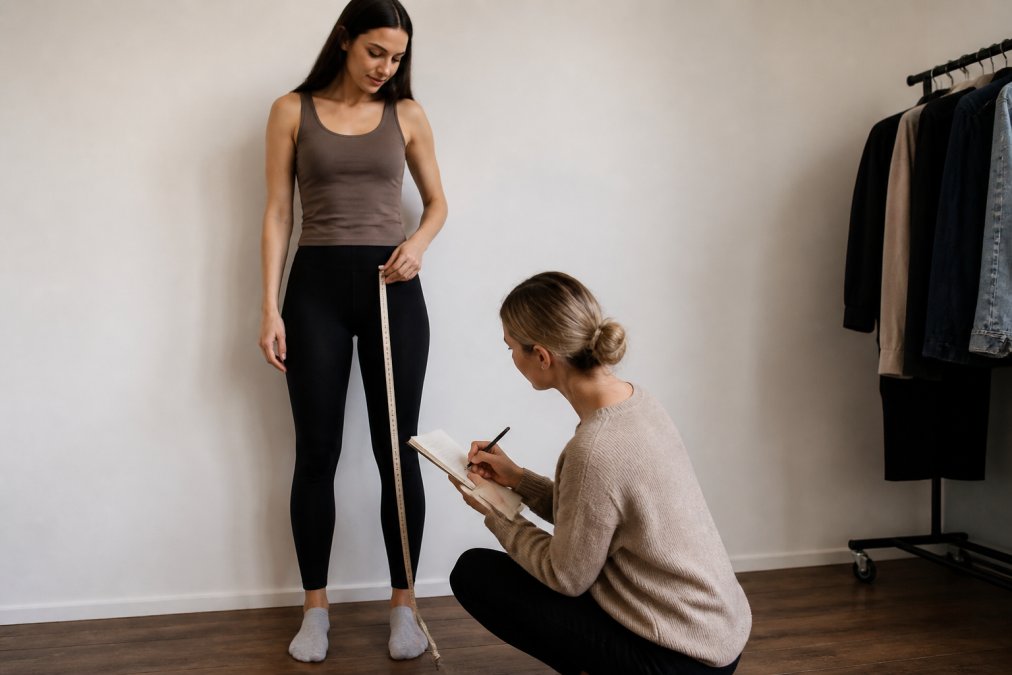
Take the same approach for the other three:
- Sleeve length: measure from the bone at the top of your shoulder, over a slightly bent elbow, to your wrist bone. Keep the arm relaxed, not locked straight.
- Torso length: measure from the base of your neck to your natural waist, the narrowest point above your hip bone. Bend sideways, the crease that forms is your natural waist.
- Rise: measure from your crotch to where you want the waistband to sit. For a high-rise pant, that is usually one to two inches above your natural waist.
Turning Your Numbers Into a Buying Decision
Measurements only help if you know what to do with them. Here is the framework most tall shoppers never get:
- Inseam: if your inseam is 34 inches or longer, standard women's pants (typically graded to a 30-32 inch inseam) will not break correctly. Look for stated inseams of 35-38 inches. A 36-inch inseam generally suits a 5'10" to 6'0" frame; 37-38 inches suits 6'1" and above.
- Sleeve length: a standard women's long sleeve runs about 22-23 inches. A genuine tall sleeve runs roughly 24-27 inches. If a product page does not state sleeve length, assume it is standard.
- Torso length: most standard tops are cut for a torso of about 15-16 inches (neck to waist). If yours measures 17 inches or more, you will need a tall-specific block or an adjustable hem.
The Tolerance Rule
No garment will match your measurements exactly, and it should not have to. A common pattern among people who sew and alter clothing is to allow about half an inch of ease at the sleeve and up to an inch at the hem without it reading as a bad fit. Beyond that, the garment starts to look borrowed. Use your numbers to judge whether a piece is within tolerance, not whether it is a perfect match.

Fashion Tips for Tall Women 2026: What Actually Works
The best fashion tips for tall women 2026 come down to two habits: read real measurements, and buy from brands that publish them. Everything else is noise.
Look for Real Sleeve Lengths and True Tall Rise
Ignore the word "tall" on a label and look for numbers instead. A genuine tall sleeve runs roughly 24 to 27 inches. A true tall rise sits at or above your natural waist. If the product page does not state these, assume the brand graded a standard pattern and added a hem.
Tall Bohemian Halter Maxi Dress →
Prioritize Fit Consistency Over Fast Fashion
| Fit Problem | What Causes It | What to Look For |
|---|---|---|
| Sleeves stop short | Grading adds width, not length | Published sleeve length of 24-27 inches |
| Waist sits too high | Standard torso proportions | Stated torso length or tall-specific block |
| Pants hover above shoes | Standard inseam grading | Inseams of 35-38 inches by style |
| Bodice pulls across chest | Width added without vertical length | Adjustable straps, true tall construction |
At Paryse Style, every piece starts from the tall body, with real sleeve lengths and inseams from 35 to 38 inches depending on the style. The Tiger Twist tall long sleeve crop top, for example, carries a full 27-inch sleeve and a twist front cut to land at your waist rather than your ribs. That is what a pattern built for height looks like.
How Poor Fit Affects Confidence (and Why It Matters)
Most articles about tall clothing stop at the technical reasons, grading, pattern blocks, inseams. Almost none address what poor fit actually does to the person wearing it. That is the part worth talking about, because it is the part that lingers.
The Adjustment Loop
There is a specific behavior pattern that tall women describe again and again, and it has a name worth giving it: the adjustment loop. You tug the sleeve down. It rides back up. You tug again. Each tug pulls your attention inward, away from the conversation, the meeting, the photo. By the end of an event, you have spent more mental energy managing your clothes than participating in your own life.
Why This Hits Tall Women Harder
A common pattern is that tall women internalize fit problems as personal failures rather than manufacturing ones. When nothing on the rack reaches your wrists, the message you absorb, even if no one says it, is that your body is the problem. It is not. The pattern was graded for a shorter frame. But that distinction is easy to lose when you have been told "tall" on a label and still come home with sleeves that stop at your forearm.
What Actually Changes It
The reverse is also true. Clothing that fits your proportions removes that background noise entirely. You stop managing your outfit and start using it. That shift is not vanity; it is the difference between being present and being preoccupied.
DIY Minor Alterations for Tall Clothing
- Let down a hem: many pants and dresses include a generous seam allowance. A seam ripper and an iron can recover one to two inches in under an hour.
- Add length to a sleeve: if the sleeve has a cuff, removing it and reattaching it lower can gain you an inch. Check that the fabric underneath is not faded first.
- Lower a waistband: on skirts with a wide facing, you can often reposition the waistband downward to sit at your natural waist.
- Adjust straps: halters and slip dresses with adjustable ties let you dial in the drop without touching a needle. Both the neck and back straps on a Paryse Style halter maxi are adjustable for exactly this reason.
A 62-inch shoulder-to-hem maxi in a flowing fabric, like the Tall Bohemian Halter Maxi in Bordeaux, needs no alteration at all on a 5'11" to 6'6" frame. That is the point of buying from a brand that starts with your proportions instead of retrofitting a standard pattern.

Frequently Asked Questions
Do tall people wear bigger sizes?
Not necessarily. Height and size are independent. A tall woman can wear a size 6 or a size 16. What changes is proportion: longer torso, longer sleeves, longer inseam. Standard sizes are graded for average height, so a size 6 tall needs the same width as a size 6 regular but extra length. Brands that only offer 'tall' in plus sizes miss this entirely.
What is the difference between 'tall size' and 'extended size'?
Tall sizing adds length to sleeves, torso, and inseam while keeping the same width as the base size. Extended sizing adds width for larger bodies, often without changing length. Some brands confuse the two, offering a plus-size cut as 'tall fit' when it does not address height at all. Look for size charts that list sleeve and inseam measurements separately.
Why do sleeves and inseams often shrink after the first wash?
Many fabrics, especially cotton and cotton blends, shrink when exposed to heat. Fast fashion manufacturing often skips pre-shrinking to save cost. A 27-inch sleeve can lose half an inch or more after one wash. To protect length, wash in cold water and air dry, or look for brands that pre-shrink fabrics and state shrinkage rates in product details.
Is there a difference between vanity sizing and actual tall sizing?
Yes. Vanity sizing inflates the number on the label (a size 8 becomes a size 4) without changing the actual measurements much. Actual tall sizing keeps the number but adjusts length and proportion for height. A tall size 8 should have longer sleeves and torso than a regular size 8, not just a smaller number on the tag.